Pages

Wednesday, January 15, 2014

Ceci's ScribePost

multiplying integers

when the integers have different value, ( - or + ) the product is negative.

when the integers have same value, ( -,+ )the product is positive.
when multiplying integers, count the negative signs
odd number = negative
even number = positive

8.2 textbook

 10. Estimate and then calculate
    1)  (+17) * (-24) = 408
 est:  (+20) * (-24) = -480
I changed 17 to 20 because 17 is close to 20, also i can calculate 20 * 24 in my head fast. 
Then i used the sign rule to solve this question, when the integers have different value, the product is negative.

  2)  (+37) * (+22) = 814
est: (+40) * (+22) =880 
 I changed 37 to 40 because 37 is close to 40, also i can calculate 40 * 22 in my head fast. 
Then i used the sign rule to solve this question, when the integers have same value, the product is positive.

  3)  (-72) * (+15) =  -1080 
est: (-70) * (+15) = 1050

I changed 72 to 70 because 72 is close to 70, also i can calculate 70 * 15 in my head fast. 
Then i used the sign rule to solve this question, when the integers have different value, the product is negative.

 4)   (-28) * (-47) = 1316
est: (-30) * (-45) = 1350

I changed 28 to 30, 47 to 45 because 28 is close to 30,and 47 is close to 45 also i can calculate 30 * 45 in my head fast. Then i used the sign rule to solve this question, when the integers have same value, the product is positive.


12. A telephone company offer its customer a $15 discount per month if they also sign up for internet service. how much is the annual discount?
     (+12) * (-15) = -180
     12 groups of (-15)
    12 month of $15.00 off
I used negative sign for $15 because discount means off (getting 15 dollars off each month)
annual means one year, there are 12 months in a year, and we have $15.00 off each year. 
so we need to calculate how much is the annual discount, we multiply 12 by -15 because we have 12 groups of -15. Then we use the sign rule to solve this question, when the integers have different value, the product is negative. 12 * 15 equals 180, the answer has to be negative so, it is -180.


13. A hot air balloon is descending at 60 m/min. how far does it descend in 25 min?
        (+25) * (-60) = -1500 
       25 groups of (-60)
      25 min of 60 m/ min
I used negative sign for 60 m because descend means going down, the hot air balloon is going down 60 m/ min.
The hot air balloon is descending at 60 m/min, and the question ask how far does it descend in 25 min? that means, we have 25 groups of 60 because , 60 m/ min, and there are 25 of them. To solve this question we need to multiply 25 by (-60). we can use the sign rule to solve this question, when the integers have different value, the product is negative.  25 * 60 = 1500, the answer has to be negative so it is 


here is a video that can help you with multiplying integers (with the chip model)
multiplying integers is not hard, you can do it!
hope my scribe can help you!


NICKNAC'S SCRIBE POST

(+5)X(+5) USING A NUMBER LINE
+5           +5         
_____>_____>   +10
__________


SIGN RULE

WHEN YOU HAVE THE SAME VALUE (++) YOUR PRODUCT IS GOING TO BE POSITIVE

WHEN YOU HAVE A DIFFERENT VALUE(+-) YOUR PRODUCT IS GOINIG TO BE NEGATIVE

(+10) X (+4)= 40


(+6) X (-5)= -30


ESTIMATING BIG INTEGER NUMBER


+37   +22   ESTIMATE    (+40) X (+20)= 800  


Tuesday, January 14, 2014

Pam's Scribe Post

integers lesson
 
When multiplying integers, here is the basic lesson.
Here's an example:
(+7) x (+2)=
In words, this would be seven groups of positive 2.
In repeated addition: (+2) + (+2) + (+2) + (+2) + (+2) + (+2) + (+2) =
You could use integer chips as so:


The red symbolizes positive.

You can also represent this equation as a number line, either vertical or horizontal.


And you'll have your answer, which is (+14).

Here's something new:

scribe rule
 
When the integers have the same value (+ or -), the product is positive.
When the integers have different values (+, - ), the product is negative.
 
Let's apply this rule.
(+5) x (+4) =
Just multiply and then see whether or not the signs match or not.
5x4= 20
both positive, so the answer is positive.
(+ 5) x (+4) = +20)
 
(-6) x (+2)=
Multiply, 6x2= 12
They have different signs, meaning it's negative.
 
(-7) x (-8)=
Find the answer of 7x8, = 56
Then to see whether 56 or the answer is positive or negative, check the signs.
The two signs are the same, meaning the answer is going to be positive.
= (+56)
 
sign rule part 2
 
When multiplying integers , count the negative signs. When the number turns out to be an even number, it is going to be a positive product, and an odd number while counting equals to a negative product.
 
For example: (+4) x (+6) x (-7) x (-1) =
count the negative signs, and there are 2.
2 is an even number, therefor the answer will turn out to be a positive product.
 
To solve it, just do order of operations.
 
(+4) x (+6) x (-7) x (--1) =
(+24) x (-7) x (-1) =


(-168) x (-1)=
(+168) = answer. :)
See, it's a positive product.

Let's try this again.
(-4) x (-1) x (-3) x (+2) =
by following the same rule from before, this must be a negative product since there are 3 negative signs, and 3 is odd.

(-4) x (-1) x (-3) x (+2) =
(+4) x (-3) x (+2) =
(-12) x (+2)=
(-24) = answer
                                       
Let's try with more factors.
(-4) x (+2) x (-1) x (+1) x (-5) x (+1) =
There are 3 negatives, and 3 is an odd number meaning that the answer is going to be a negative product.

(-4) x (+2) x (-1) x (+1) x (-5) x (+1) =
(-8) x (-1) x (+1) x (-5) x (+1) =
(+8) x (+1) x (-5) x (+1) =
(+8) x (-5) x (+1) =
(-40) x (+1) =
(-40)= answer.
See it wasn't that bad.
If you're having problems with multiplying integers, please refer to the video below,


P
Please feel free to play this game, and apply the sign rules to your answers. :)


Integer Multiplication Game

Have fun, and Good Luck! :)

Monday, January 13, 2014

Joanna's Scribe Post


Multiplying Integers
January 13, 2014

    There are 4 different kinds of equations that you'll might come across whenever you are multiplying integers.
Here are some examples...

(+2) x (+6)                (+2) x (-6)

These two equations have one important thing in common. Both equations are able to make groups or in other words, you are using repeated addition. 
What is repeated addition?
How do you make groups?

Repeated addition is another way of multiplying. Instead, we add the groups of numbers we need. In this situation, the equation is...
 (+2) x (+6)
Repeated Addition is simple...         (+6) + (+6) = (+12)
As you can see, we are technically adding instead of multiplying. 
The equation asks you for 2 groups of +6 meaning, you should end up with 2 positive 6s'
                      two groups of 6                                                              (+6) + (+6) = 12  
                                     words                                                                                            repeated addition


Here is another equation that relates to making groups

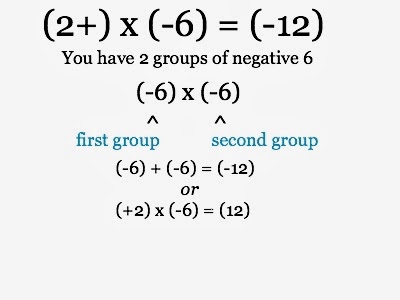
(+2) x (-6) 

This is a different equation because instead of making groups of positive numbers, you are making groups of negatives. The steps are still the same.

You have two groups of (-6)

(-6) + (-6) = (-12)

              two groups of negative six                                                    (-6) + (-6) = (-12)  
                                  words                                                                                                repeated addition


The next equations will be a little different. Instead of making groups, we are removing them.

(-3) x (+3)                        (-3) x (-3)

The trick is to add zero pairs

♫ Whenever something is not there, You must add a zero pair! 

(-3) x (+3) 

In words this would be, remove two groups of three

You must indicate the arrows pointing out. This will show that you are removing.


Remove two groups of positive three = owe 9

(-3) x (-3) 


Remove three groups of negative three = have 9

Making groups - join the party
Removing groups - leave the party

Here's a video that I hope will make it easier for you to understand multiplying integers


Also, if you feel the need for a game to help you with this topic, try this game out!


Thanks For Reading
&
Good Luck!


Katrina's Integer Scribe Post


Adding and Subtracting integers  


Example.

+7+-2= -5
have 7 and owe 2= owe 5

If you have to show the work you put 7 positive and 2 negatives.
+ + + + + + +
-  -            

After you draw you find the zero pairs.

+ + + + + + +
-  -            

That is how you get the answer. 

Removing

To add or subtract something that's not there you have to do the zero pair. You only use the zero pairs when you happen to see 2 negative sign right beside each other.

Example: 

6-(-9)= 15

have 6 and remover -9

+ + + + + +    - - - - - - - - - >>>>>> remove
                      + + + + + + + +

+ + + + + + + + + + + + + + + = 15


~ We have 6 and we owe9 but we can't remover 9 from 6 because 9 is a higher number than 6, so we have to add the zero pairs. We need to add 9 zero pairs and remover 9 zero pairs. Now we have 6 and have 9, we add those two numbers together and we got the answer. :)

6+9= 15


examples.

(-3) - 5= -8 ( we don't have to remove because we only remover when we have 2 negative sign together -(-7) ) 

owe 3 and owe 5= owe 8


1 -(- 2)= 3

Have 1 and remove owe 2= Have 3

+       - - >>>>>>>>>>>> remove.
        + +

+++= have 3

(-8) - 4= 12

owe 8 and owe 4= owe 12

- - - - - - - -    - - - - 

Lizley's Pay It Forward

We start volunteering at Winnipeg Harvest on our 2nd week here in Winnipeg. My parents joined first, then they invited us to volunteer for the next Saturday, so we start to volunteer every other Saturdays. We volunteer sorting breads, creating boxes, cleaning and sorting goods. We work from 9:00 am to 12:00 pm.


Mariana Santos 8-14


Percent- is an equivalent fraction out of a whole.

Part 1 - How to find key percents 


  • 50% - I can find 50 % of a number by dividing it by 2
  • 10% - I can find 10% of a number by dividing it by 10
  • 1% - I can find 1% of a number by dividing it by 100 
  • 25%- I can find 25% of a number by dividing it by 4

Part 2- You need to have 3 images showing Representing Percents.  You choose the 3 but you could


  • 180% 

  • 12 3/4 % 
  • 0.7%


    3.You need to explain how to convert from Decimals to Percents to Fractions.  Choose 3  sets
    • 26%                           
    • 7/10 ( 7/10 x 100 = 
    • 0.024                           


Wikipedia

Search results

Creative Commons License